
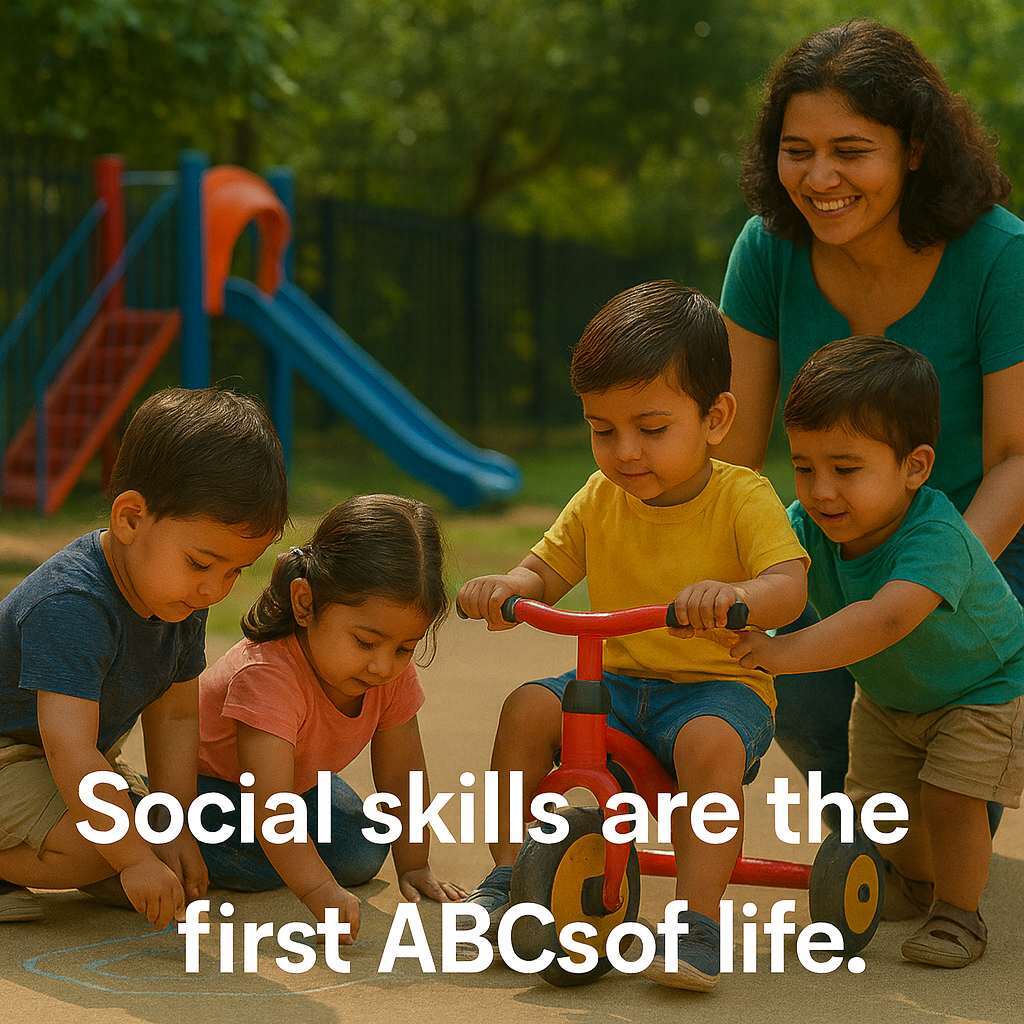
Upward International Preschool & DayCare – Preschool in Thane West focuses on holistic early childhood development, where social skills matter even more than memorising ABCs at age 2. In this article, we explore why emotional and social readiness forms the foundation of lifelong learning.
When your child turns two, it’s natural to start worrying about when they’ll say the alphabet, count to ten, or recognise shapes. Parents often compare milestones—“Does my child know A, B, C yet?” But research in early childhood development consistently shows something important: at this age, social skills matter far more than memorizing ABCs.
Why are social skills important in early childhood
The research, Early Social-Emotional Functioning and Public Health: The Relationship Between Kindergarten Social Competence and Future Wellness, tracked 753 kindergarten students in the United States for two decades and found “kindergarten students who exhibited traits such as being more likely to share, cooperate, or be helpful with other kids were also more likely to be successful as young adults”.
“In contrast, students who exhibited weaker social competency skills were more likely to drop out of high school, abuse drugs and alcohol, and need greater government assistance.”
The Real Foundation of Learning
At two years old, children are not just tiny learners—they are explorers, communicators, and social beings. Their ability to share toys, express emotions, follow simple instructions, and play with peers forms the foundation for all future learning. These are called social and emotional skills, and they are closely linked with how well children adjust to preschool and eventually perform academically.
Why Social Skills Come First
1. School Readiness Begins with Relationships
Children who can take turns, listen, and manage emotions are more ready for group learning. A child who can cooperate in play learns naturally—whether it’s through building with blocks, role-playing, or listening to a story.
2. Confidence Builds Curiosity
When children feel secure interacting with others, they explore more boldly. A confident toddler is more willing to try puzzles, count blocks, or sing songs—laying the groundwork for academic learning later.
3. Language and Social Growth Go Hand in Hand
At this age, words matter less than conversations. Toddlers expand vocabulary through play and interaction: asking for a toy, naming feelings, or sharing a pretend game. These social exchanges boost both language and thinking skills.
4. Behavior Skills = Learning Skills
The ability to focus, follow directions, and regulate emotions allows children to learn letters and numbers more effectively when the time comes. Without these social skills, even the brightest child may struggle in structured preschool settings.
Why This Matters in Choosing a Preschool
If you are looking for a play-based preschool in Thane, focus on programs that value social and emotional growth just as much as early academics. A play-based environment encourages toddlers to:
- Cooperate in group activities
- Develop empathy and kindness
- Explore curiosity without pressure
- Learn through guided play and discovery
Such preschools balance academics with play, ensuring children not only recognise letters and numbers eventually, but also gain the confidence, resilience, and social awareness to thrive in school and life.
The Research Perspective
Decades of research in early childhood education point to the same conclusion: children who develop strong social skills in the toddler and preschool years are better prepared for academics, more successful in primary school, and more adaptable in the long run. In fact, pushing rote memorization of ABCs at age two can sometimes create unnecessary stress, while prioritising social development ensures children enjoy learning instead of fearing it.
Upward International Preschool & DayCare – Preschool in Thane West that focuses on social skills provides a strong foundation for academic and personal success as children grow.
Conclusion:
At age two, your child’s greatest achievement is not reciting the alphabet—it’s learning how to play with others, express emotions, and discover the joy of learning. Choosing a nurturing, play-based preschool in Thane ensures that your child develops these essential life skills first, building the strongest possible foundation for everything that comes next.
FAQ’s
Q1. Should I stop teaching ABCs to my 2-year-old?
No. You can introduce letters and numbers through songs, books, and play. But don’t make it a pressure point. At this age, focus more on social play, communication, and exploration.
Q2. What social skills should a 2-year-old have?
Simple ones—sharing toys, showing empathy (“Are you okay?”), following one-step instructions, and playing alongside peers. These are stepping stones for later teamwork and classroom readiness.
Q3. Why do experts emphasise play-based learning at this age?
Play is the natural way children learn. In a play-based preschool in Thane, children practice social, emotional, and problem-solving skills while having fun—making learning joyful and meaningful.
Q4. Will my child fall behind academically if I focus on social skills first?
Not at all. In fact, research shows the opposite. Children with strong social and emotional skills grasp academics faster once they enter preschool and primary school.
Q5. How do I know if a preschool is the right fit?
Look for a program that balances guided play, group activities, and early academics. Visit the classroom to see if the children are happy, engaged, and interacting. That’s the best sign of healthy learning.
By focusing on social skills over ABCs at age two, you’re giving your child a gift far greater than early academics: the ability to connect, cooperate, and thrive.